


Transport Waste Food Shelter Water Energy
Share/Save/Bookmark Site Map Link to Us

Home : FOOD : Aquaponics


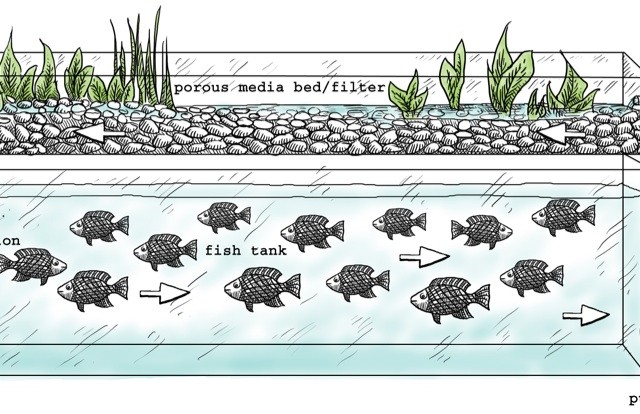
Aquaponics is the practice of growing vegetables and fish together in a man-made ecosystem.  It can be much easier than it sounds and produces more food per unit of space than any other food production system.  The key concepts here are water flow, fish stocking rates, and plant stocking rates.  Our system involves a continues flow system with plants in containers hanging above the fish tank.  A solar pump pumps the fish waste and water up to the plants.  The clean water then falls back down to the fish tank.  It is a self-contained system that can grow enough food for a family in an area smaller than a hybrid car!

Fish wastes are excellent organic fertilizers, as they contain many trace elements and are mostly ammonia.  The unfortunate fact, however, is that they build up quickly and soon kill the fish that created them (sound familiar?).  To avoid a mass kill-off, it is essential to filter the water.  One of the simplest and best ways of filtering water is to establish a bio-filter.  Bio-filters work by growing friendly bacteria on a substrate, like gravel.  The bacteria break down the fish wastes into soluble nutrients that can be available for use by plants and aquatic life systems.  By running the water through plants as well, these nutrients get taken up by the plants and the water is returned to the fish very clean and fresh and oxygenated.

By establishing a good bio-filter you can increase the stocking rating of the fish, thus increasing production.  On average, you can grow 7 tons of food to one ton of fish waste. For most systems, aim for a 2 to 1 ratio of bio-filter volume to fish tank volume.

Simple Aquaponics System

Materials
Small HDPE horse trough
80 2 liter soda bottles
solar water pump
wire shelving units
a few bricks
small irrigation hose
coarse gravel

Place the trough on a level sand bed.  Place 4 bricks in the trough, and then put the shelves across the bricks.  Place a layer of coarse gravel over the entire bottom of the trough.  Next, fill each soda bottle with at least 8 inches of coarse gravel.  Poke 4 holes in the bottom of each bottle and place them on the shelves. Run irrigation hose  along the tops of the bottles, and poke small holes in the hose at each bottle.  Connect the hose to the solar pump, place the pump at the bottom of the trough.  Fill the trough with un-chlorinated water, until the level of water is 4 inches below the bottom of the bottles. Connect the pump to the solar panel and watch the flow.  Make sure each bottle is dripping water.  Place some pond water in the trough and a few rocks from a pond or river.  This will get the bacteria going.  Run the system for at least 2 weeks before adding fish or plants.

At first, add 10-15 small fish and plant only 1/3 to ½ of the plants. Good fish are catfish, carp, bluegill or tilapia (warm climates only).  Good plants are tomatoes, peppers, squash, melons, cucumbers, lettuce, brassicas, spinach, most herbs.  Root vegetables can be grown but on average don't do as well.

As your systems develops, slowly add fish and plants until you have about 30-50 fish and every plant space taken up.  At between 4 and 6 months after you put in the original fish, you can start harvesting.  As you harvest fish, harvest plants as well.

It can take some time to establish a fully-functional eco-system, but as it develops, pay close attention to the clearness of the water, the growth of the plants and fish, and the flow rate of water.  If the water becomes overly cloudy, check the pump and reduce the fish population (eat fish).

You can feed fish plants that you grow in the system or have a secondary, stagnate system where you grow duckweed and fish-food.  Another auxiliary fish food system is a worm compost bin.  Use the plants byproducts from the aquaponic system to grow the worms. Use the worm compost in your dirt garden, and feed the worms to the fish.


EXTERNAL RESOURCES
Wikipedia: Aquaponics

Backyard Aquaponics
Aquaponics
Barrel Ponics
 
BOOK SUGGESTIONS
The Encyclopedia of Country Living: An Old Fashioned Recipe Book By Carla Emery

Storey's Basic Country Skills: A Practical Guide to Self-Reliance By John Storey, Martha Storey

The Self-sufficient Life and How to Live It By John Seymour

The New Complete Book of Self-Sufficiency By John Seymour

Prescription for Natural Cures By James Balch, Mark Stengler

Healing With Whole Foods: Asian Traditions and Modern Nutrition (3rd Edition) By Paul Pitchford

PERMACULTURE: A Designers' Manual (Hardcover)by Bill Mollison (Author), Reny Mia Slay (Author)

Country Wisdom & Know-How (Paperback) by The Editors of Storey Publishing's Country Wisdom Boards

How to Grow More Vegetables: And Fruits, Nuts, Berries, Grains, and Other Crops Than You Ever Thought Possible on Less Land Than You Can Imagine By John Jeavons

Aquaponics-integration of hydroponics with aquaculture (Horticulture systems guide) (Unknown Binding) by Steve Dive


Visit Store >>>

Book Search >>>


Share/Save/Bookmark Site Map Link to Us


HOME ENERGY WATER SHELTER FOOD WASTE TRANSPORT DONATE STORE CONTACT
SITE MAP SAFETY LINK TO US ADVERTISING TERMS OF USE

   If you would like to sponsor a page or project, please visit the Advertising Section.

    All information contained herein, including text, images, videos, sounds or any form of media and/or content is Copyright 2008 Vela Creations.