


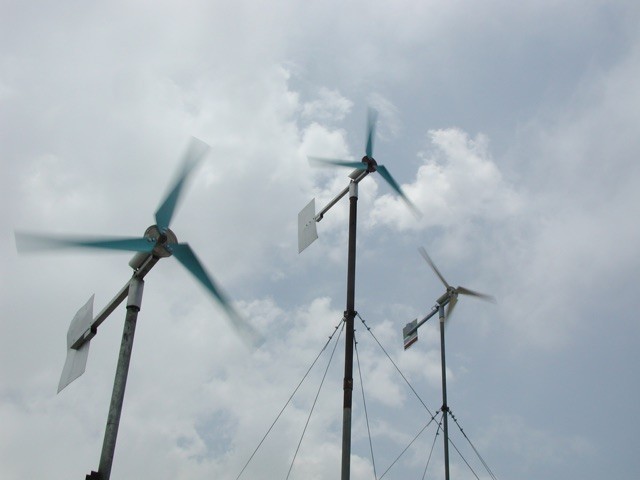
We originally made a small, 100-watt wind generator in 2004. We called it Chispito. At the time we had very few resources, and solar panels were expensive. So we made Chispito using junk as a cheap addition to our off-grid power system. Since the prototype, we have made several modifications, and have now gone on to make a couple of 1000 or 1500-watt machines, which we call Gordo.
We have full instructions on how to build a Chispito generator and a wind generator tower, but in this article, we wish to address some of the safety issues and FAQ that have come up over the years.
Electricity, especially when spinning blades are also involved, can be extremely dangerous. Bare in mind all safety warnings that you come across, even if they sound ridiculous.
The user of this information assumes full responsibility for his/her safety.
Here are some of the things you need to consider:
We’ve had a ton of questions since the release of Chispito. This page covers most of those questions, but if you can’t find your answers here, contact us.
Refer to the comments on the Chispito Instructables: http://www.instructables.com/id/Chispito-Wind-Generator/
What can this wind generator produce?
Chispito produces 100 watts in a 30 mph wind at 12 volts DC. It starts charging a 12 volt battery around 7-10 mph, or 270-300 rpm.
Do I have enough wind to use a Chispito?
You probably have enough wind at times, but maybe not all of the time. Chispito needs 7-10 mph to start charging a 12 volt battery, and 15-20 mph is best.
I have a motor here, can I use it?
Maybe. The motor should be permanent magnet and have 25-35 rpms per volt. For more information, please see the section below on parts.
Where do you get that motor?
The particular motor we use in the instructions comes from a treadmill. You can use different treadmill motors as long as they have permanent magnets and have 25-35 rpms per volt. For more information, please see the section below on parts.
Can I mount the motor directly to the pipe flange?
No, don’t do this, you won’t be able to balance the mount. Attach the motor to the square tubing, then attach the square tubing to the pipe flange at the balance point.
Do you offer Chispito kits or parts?
We did offer kits at one time, but we don’t offer them anymore. We won’t be offering them in the future. Get to know your junk yard!
Can I put a Chispito on my car, then go down the road and charge a bank of batteries that then powers my car?
You could put a Chipisto on your car, and yes, it could charge a battery as you drove down the road. Will it produce more power than you are using to drive down the road? No, see Newton’s laws or take a basic physics class. That is like asking does water run uphill.
Where do you find 8” PVC?
Check your local well driller for scrap pieces. Also, sometimes irrigation supplies will have them. City sewer and water departments might have some scraps as well. Because you only need 2 feet of pipe, it will be easy to find a scrap instead of trying to buy a piece.
Can I use another size of pipe?
Yes, but performance will be different. You can alter the size of the pipe to get different results. For more information, see the section below on parts.
Can I use fan blades?
Yes you can, but your performance will be poor. There is a difference between catching wind and creating it. The blades in the instructions are easy to make, so start there.
What size of copper wire do you suggest to hook to the batteries?
We suggest at least 10 gauge stranded wire. The best stuff is fine stranded welding cables, as they are tough, but more expensive. Do not use solid wire, it will break.
Won’t the wires twist up as the wind generator follows the wind?
Yes and no. They do and can twist, but is it a problem? Not for us. A good remedy is to place a plug at the bottom and untwist the wires once every few years, if it becomes a problem. Or use welding cables, they will untwist. We do not recommend implementing skips rings, as they are likely to fail, and will allow the generator to spin very fast, creating a safety hazard.
What batteries do I use with a Chispito?
Deep cycle lead-acid batteries work well. Car batteries will work, for a little while, and then fail. Get deep cycle batteries. Golf cart batteries are good, and you can usually get free old ones from golf courses.
What type of controller should I use with Chispito?
Dump load controllers are best with wind generators. Basically, when the batteries get full, they dump the extra energy coming from the wind generator into a dump load, like a water heater. There are many sources and types of these controllers. Do not use an in-line controller, like you would use with a solar panel. These series controllers disconnect the wind generator when the batteries are full, allowing it to free spin and throw parts and blades at your head!
Is making Chispito expensive or difficult?
It shouldn’t be. Making Chispito should be fun and educational. If it is frustrating, take a break, and come back to it later when you can enjoy it. Don’t force it, work with the process, not against it. Make it a friend and family event to make the most of the experience.

Parts can be hard to find at times. If you have something that might work, test it out. If it does work, let us know, so that we can tell others about it.
The motor is the core of Chispito. Without it, forget about the rest. You are looking for a permanent magnet motor. Why permanent magnets? Because they work well as generators, which is what we want here. Also, they don’t normally require high rpms to get some usable power out of them. To find out if your motor might work, look on the label and find the rpms. Then, find the working voltage. Divide rpms by voltage to get rpms per volt. For this sort of machine, you are looking for 25-35 rpms per volt. The more rpms per volt, the faster Chispito needs to turn to charge a battery, which means you will need more wind before it will start charging. So, go for low rpms per volt.
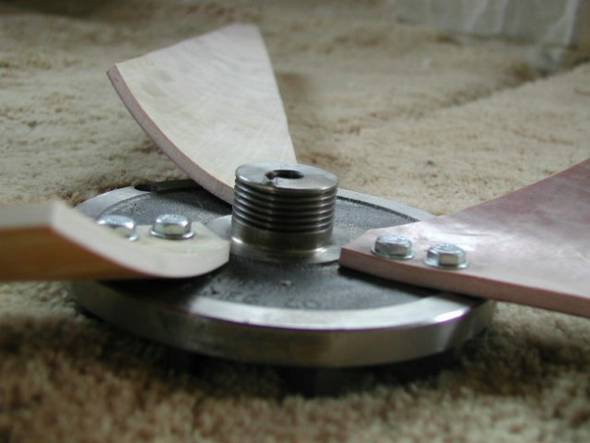
The motor should also have a hub attached. If it doesn’t, you’ll have to find something that works. Saw blades, pulleys, and hubs from something else might work, but remember, this thing can get up to 1500 rpms, so get that hub on there tight!
The motor should be easy to turn by hand, and it should produce a bit of voltage with a hand turn. Something in the range of 1-2 volts with a hand turn will be great. If in doubt, hook the motor to a lathe or drill press to get a good representation of what it will output at set speeds. If the machine can’t get power out of it, neither will the wind.
These blades are designed to be cheap and easy to make. That being said, blades can be very dangerous. Our suggestion is to use the thickest material possible, and for heavens sake, paint it! PVC is vulnerable to UV damage, so paint will help with that. The green sewer pipe that is 3/8” thick makes great blades that are durable. We have had several sets that have survived falling from 20 foot towers!
Other sizes of pipe will work, but performance may change. If you use below 8 inches in diameter, it might be an idea to use 4 blades instead of 3 on your Chispito. Make the blades as wide as you can, and maybe a few inches longer.
Longer blades will help start the generator at lower wind speeds, but the output on the high end will be lower. Design for what winds you have. If you only get small breezes, then make your blades wide and long, and maybe add an extra one. If you get hurricane winds every day, keep the blades short and thin, and you’ll easily produce a bunch of power with this machine.
The mount and tail should be sturdy. Weld the mount to the yaw pipe, if at all possible. Also, make sure your tail is on there good. If it vibrates, then add a bolt that goes all the way through the mount.
Tails are more effective if they are big, so don’t skimp on the size. We like the metal casing of washers and dryers for our tails. Those cases will make a lot of tails, so make them as big as you can.
Balance of the mount and tail are extremely important. Without proper balance, the machine will vibrate and create stress everywhere. It will also be noisy. So, add weights, drill holes, and do whatever you can to get it as balanced as possible.