

Home : ENERGY : Off-grid Power System |
|
Sizing Your System Determining your system’s size can help prevent overuse or damage to system components down the line. Start by evaluating your appliances in your home. Record how many hours a week you use the appliances and how much energy each consumes, in terms of watts. For instance, a lamp with a 40-watt bulb (an extremely inefficient light bulb these days!!) that is on for 5 hours a day will use 40 watts for 35 hours a week, or 1,400 watt-hours a week. Once you get your typical energy consumption for a week, you can design your system to generate enough power in a week to keep your batteries fully charged. Your battery bank should be able to last you at least one week without any energy coming in. Say you want a battery to cover the above 1,400 watt-hours a week. At 12 volts (volts*amps=watts or watts/volts=amps), your battery bank will need a capacity of at least 117 amp-hours. Your sources should be able to keep your batteries fully charged all the time. Lead-Acid Batteries should never go below 80% capacity for a longer life. In a general day, your sources should be able to completely recharge your bank. So, for the above example, we will need to produce 117 amp-hours at 12 volts in a week, or 16 amp-hours a day. Sources will be rated in watts, but their outputs can vary. A 120 watt solar panel is producing 15-18 volts and 6-8 amps. It will produce less in the morning and evening, but in our area, we can get 25-30 amp-hours average daily from our 120-watt solar panel. So, now we are producing more than we are using. Is this a problem? Not really. This is actually good, and the system should be designed to use this extra energy for something useful. Water Heaters work great for this as a diversion load for your system. When your batteries get full, the diversion controller turns on the water heater and uses the energy coming in from the source. The controller and diversion load should be designed to handle the maximum output of all the sources. Diversion loads can be stacked to come on at different intervals, giving your system a sliding scale, depending on how much power is coming in at the time. Once the usage, storage, and source capacity has been determined, you will need to decide how to use the energy. What appliance will be on 12 or 24 volt DC and which ones will be run through an inverter? Your inverter should be sized 25% larger than your biggest draw. Inverters are rated in watts and have a surge rating, but most users have found that surge ratings are useless. So, the above lamp is pulling 40 watts, so we would need at least a 50-watt inverter convert to 120 volts AC. Wire size can play a big role in the efficiency of your system. For DC, wires should be copper stranded and as large as possible for lower line loss. The inverter should be as close to the batteries as possible and should use a big battery cable.
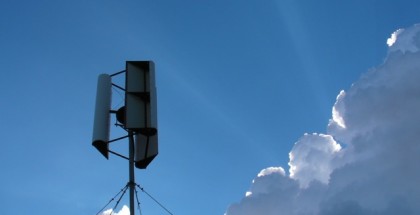
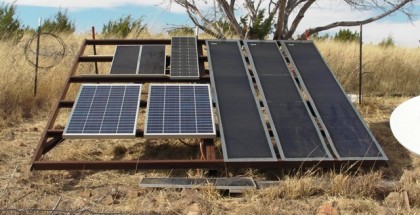
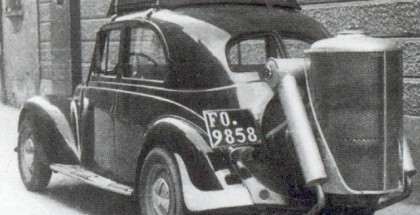
Wind turbines, hydro systems and solar panels are among the most efficient sources for a home user. Biofuels can also be used, especially to compensate other sources for special needs, such as high-drain appliances. Your sources will depend on your needs, and some areas are suited for certain types of sources. It is also important that the sources of power be easily maintained, serviced, and even built at home. Wind and hydro systems can be built at home using basic tools and salvaged materials. The Chispito Wind Generator, for instance, can attain 100 watts and costs under $50 to build at home. And that’s just the start. Home-built wind systems can get into the 5-10KW range, using nothing more than salvaged parts, magnets, and copper wire. Photo Voltaic Solar power is trickier, mainly because most of us can’t build the cells at home. You can buy cells and assemble them into panels for about $3 a watt. Prices for pre-manufactured panels range from $4.00 a watt to $5.00 a watt. Many home experimenters have dabbled with solar engines, which may hold some promise when compared to the high prices and availability of solar cells. Solar engines usually have a collector and a sterling-type engine that converts heat into mechanical energy that can then be converted into electricity by means of a generator or dynamo. A hybrid system is the way to go. A little solar, some wind, some hydro, and a renewable fuel, each providing a little, but together they provide a lot. Your system should be built around what you have. If you have more sun, use more solar, but if you are on a hilltop, use more wind. If you have a running stream through your back yard, you have a nice backyard, but you also have a dependable source of energy right at your fingertips. Hydrogen is a hot topic these days, and with good reason. It can be used to make electricity several different ways, and it can also be burned. It is the most abundant element in the universe, yet it is hard to store and reacts with lots of things. Hydrogen can be made and used at home, but requires close attention and very strict safety measures.
So, what is a battery? A battery converts the electrical energy from your generator or solar panel into chemical energy by means of a specific chemical reaction. When you need to use electricity, the battery reverses the chemical reaction and releases electricity. Batteries come in all shapes and sizes, but for most small home systems, deep cycle lead acid batteries are used. These batteries can be found in most cities, and have many applications including golf-carts, forklifts, and telephone lines. Lead-Acid Batteries are rated in Amp-Hours, which means they contain a certain amount of time at a particular electrical draw. A 200 amp-hour battery with a 20-amp draw will be discharged in 10 hours of use. So, if you had a lamp that pulled 2 amps, you could light a room for 100 hours. Most batteries in this class come in 6-volt sizes, but most appliances are at least 12 volt. To get around this, we use two 6-vot batteries, wired in series, to get one 12 volt battery. Then, our 12-volt batteries are wired in parallel to give us more amp hours. Our system voltage is always 12 volts. Because batteries are expensive and are not the most environmentally friendly component, you will want to make them last as long as possible. Checking the water level regularly is vital, and should be part of your general maintenance schedule. Another key factor in the lifespan of your batteries is not leaving them drained too low for too long. We have learned the hard way, and it has cost us dearly. Now, we try not to drain our system below 12.0 volts (a battery is full at 12.6V), and so far we have been very pleased with the performance of our battery bank. One thing to note when reading the level of your batteries is that you will only get a true voltage reading when there is no power coming in. For example, if there is no wind or sun, and hasn’t been for a while, your voltage reading will tell you exactly what your batteries are sitting at, 12.6v being the maximum. However, when the wind is blowing, your voltmeter might read anywhere up to 14.6. This is because you are reading an average of what your batteries are sitting at and what is coming in. The closer the batteries are to full, the less the act as a voltage buffer, and the voltage rises faster.
Regulating your sources can be done in several ways, most commonly, using a charge controller. The charge controller can read when your batteries are full, and subsequently cuts out the source, so that no more power comes in. Then, when the level of the batteries drops a little, the charge controller will switch the source back on. Of course, if the charge controller cuts out the source, there is effectively a bunch of power that is being wasted (not being used). To counteract this, you can use a diversion, or dump, load, which uses up the excess energy when your batteries are full to power something like a hot water heater or air compressor. Manual cut-off switches are essential for safety purposes. If you need to work on any part of the system, it helps to have a way to easily shut off any electricity coming in. Your system should always be fused between the source and the battery, and also between the battery and the appliance. That way, if something should happen, the fuse will blow, interrupting the circuit, and your components will remain unharmed. Fuse your system as close to the batteries as possible. You will also want a voltage meter to check the state of your batteries and an ammeter on each source to show how many amps your source is generating. Proper system health can be achieved with the proper controls, regulators, and metering. |
|
|||||
| HOME ENERGY WATER SHELTER FOOD WASTE TRANSPORT DONATE STORE CONTACT | |||||
| SITE MAP SAFETY LINK TO US ADVERTISING TERMS OF USE | |||||