Transport Waste Food Shelter Water Energy
Share/Save/Bookmark Site Map Link to Us

Home : WASTE


Humans can do one thing better than any other animal: produce waste. We produce billions of tons of garbage daily, and we are rapidly running out of places to put it. The current methods of waste disposal are very much “out of sight, out of mind”, and so, like cats, we bury our waste, hoping that we never have to deal with it again. But we do. The ghosts of this waste come back to haunt us in our ground water, our foods, our air and even in ourselves. The approach to hiding waste from public view must come to a halt, and place the problem right in our faces so that we may be able to deal with it in a logical and civilized manner.

There are things that you, as an individual, can do to prevent this overwhelming problem of garbage. By avoiding waste and conserving resources, composting all organic matter, producing fuel with some organic matter, reusing and recycling non-organic matter, your waste disposal needs will be very small. Just about anything can be reused, even a rotten tomato! The best part of this approach is that you get extra resources for doing very little. Instead of costing money, your waste makes it!

Avoiding waste
Avoiding waste is probably the most important factor in self sustainability. Waste is a symptom of inefficiency. Where there's waste, there is a gap in the resource cycle; something ain't right. This approach does not only apply to garbage like diapers and plastic wrappers, but also to energy, water, shelter, and transportation. Take only what you can use, leave the rest. It's as simple as that, and when it is not that simple, use the inefficiencies of one system as an input to another. Humanure becomes the feedstock to a methane digester, compost becomes food for the tomatoes, extra electricity heats water, and so on.

So you've reduced your waste until you are producing hardly any at all, right? Wrong! Your body produces a pound or more of waste daily. It is an ongoing process. When you make lunch for the kids, there is always something left over, the banana peels, the tomato stems, the bean pods.... something. Now, lots of organic matter can be used as animal feed, if you have the animals. Kitchen scraps are great for this purpose, and your animals will think it is Christmas. In our house, the chickens “expect” scraps now, and if you don't provide, they get angry!

Composting
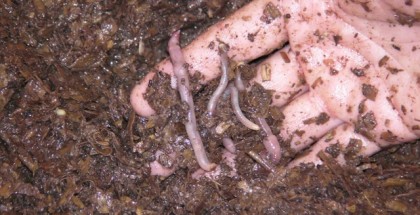
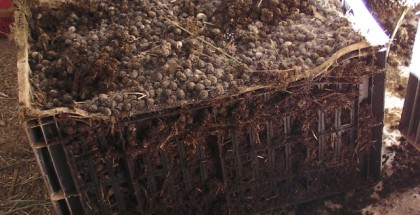
But there is always something left, even the chickens shit. To deal with organic waste, there are two routes, aerobic and anaerobic composting. Aerobic composting is what you see when there is a big pile of weeds in the corner of the garden. It is compost in the precense of oxygen. Composting in this manner is not rocket science, and most of the time, it'll happen with or without you. Very little is needed, but what is produced is perhaps the best soil addition you could ever hope for.

Waste Water
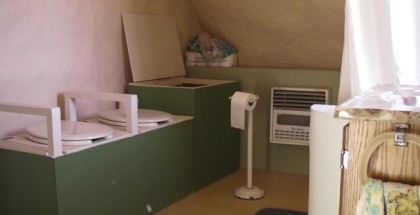
We strongly believe that archeologists will look back on our time and see the flushing toilet as the most confusing and inexplicable item of our culture. To use clean water to flush away shit is a waste of both of these useful items. Not to mention that when shit sits in water, especially underground, the pathogens than can exist in it are allowed to breed uncontrollably. With that in mind, we will not even discuss black water as a viable part of any waste water system; its only worthwhile place belongs as part of a methane digester. Grey water, on the other hand, is an extremely beneficial waste water and plays an integral part in our overall system.

Methane
Anaerobic composting is a whole other ballgame. It is composting without oxygen, which means, you have to keep that oxygen out of there! This is simply done by making a container, adding some water, keeping the temperature constant, and the bacteria do the rest. Their byproducts are Co2 and methane, often galled biogas. Biogas is an excellent fuel, especially for stationary application like cooking, small generators, heating water or the house, or anything that needs a flame. Biogas is very similar to the natural gas that you pay for, and actually, Natural Gas is the one fossil fuel that is renewable. All you need is organic waste and the right conditions.

Reduce, Reuse, and recycle
Reduce, Reuse, and recycle. That sums it up in a nutshell, but how exactly do you reuse a plastic bottle? How do we make use of an old tire? And what is the process of recycling Styrofoam? When we refer to reusing and recycling, we are not talking about taking things to a recycling center. We are talking about YOU actually doing the reusing. Like reusing glass bottles as containers, using plastic in your aquaponics system, using that old tire as a flower bed. This is where we can have great fun and be very creative finding uses for everything! You can take this a step further and actually search out other people's junk for needs you have around the place. The Chispito Wind generator is a great example of this. It can be made from parts in a junk yard, and actually, so can most things around your house.

Puro Yonke is the idea that everything or almost everything can be made from pure junk. When you use junk or garbage, you are giving new life to an old material. This makes the manufacturing of that material even more efficient, and makes the energy that was used in manufacturing that material go even further. Now here's a nice thought, using junk to make energy. It is easily done, and it could potentially mean that the energy used in creating the junk is less than the energy the junk has created. Kinda cool, huh? So get out there and make something FOR yourself!


EXTERNAL RESOURCES
Wikipedia: Waste Heirarchy
Wikipedia: Vermicompost
Wikipedia: Compost
Wikipedia: Humanure
Wikipedia: Greywater
Wikipedia: Recycling

Diaper Free Baby
Frugal Living
Getting to Zero Waste
Malcom Beck
Soil and Health Library
Journey to Forever Composting
How to Compost
Humanure - Jenkins
Rodale Institute
Open Directory Greywater
Greywater Central
Greywater Guerillas
PES Wiki Greywater
Appropedia Greywater
Greywater.com
Freecycle.org
Junk Tech
Instructables
Make Magazine
Trash to Treasure

 
BOOK SUGGESTIONS
The Humanure Handbook: A Guide to Composting Human Manure, Third Edition By Joseph C. Jenkins

The Rodale Book of Composting: Easy Methods for Every Gardener From Rodale Books

Builder's Greywater Guide: Installation of Greywater Systems in New Construction & Remodeling; A Supplement to the Book "Create an Oasis With Greywater" By Art Ludwig

The Secret Life of Compost: A "How-To" & "Why" Guide to Composting-Lawn, Garden, Feedlot or Farm By Malcolm Beck, Charles Walters

Methane Generation from Human, Animal, and Agricultural Wastes (Paperback) by National Academy of Sciences

Reduce, Reuse, Recycle: An Easy Household Guide (The Chelsea Green Guides) (Paperback) by Nicky Scott

Methane Digesters for Fuel Gas and Fertilizer (Paperback) by L. John Fry & Richard Merrill

Easy Composters You Can Build By Nick Noyes

21st Century Essential Guide to Methane and Biogas: Landfill Methane and Manure for Energy, AgStar Program, Recovery and Mitigation, Greenhouse Gas Emissions ... Biofuels, Bioenergy, and Biobased Products (CD-ROM) by World Spaceflight News

Save Water (Environment Action!) (Library Binding) by Kay Burnham
Visit Store >>>

Book Search >>>


Share/Save/Bookmark Site Map Link to Us


HOME ENERGY WATER SHELTER FOOD WASTE TRANSPORT DONATE STORE CONTACT
SITE MAP SAFETY LINK TO US ADVERTISING TERMS OF USE

   If you would like to sponsor a page or project, please visit the Advertising Section.

    All information contained herein, including text, images, videos, sounds or any form of media and/or content is Copyright 2008 Vela Creations.