


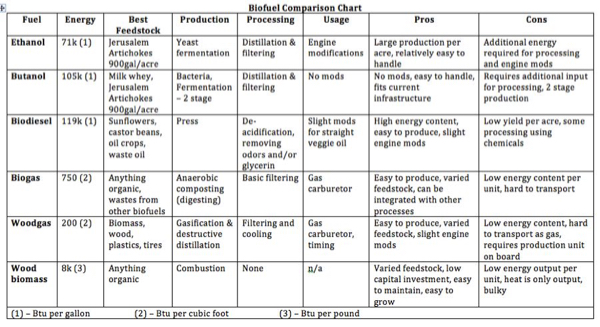
Here’s a chart comparing the pros and cons of different biofuels, to help decide which fuel to use.
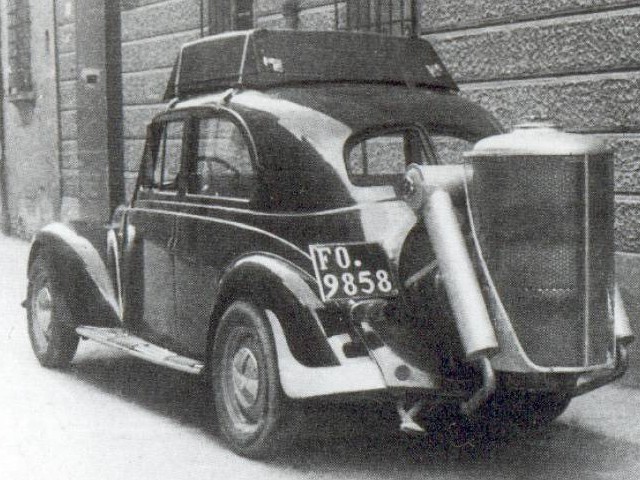
Wood gas or Producer gas is a very old form of fuel that is easy to produce and use. It consists of partially combusting biomass, and then burning the smoke and gas as a fuel.
It sounds stranger than it really is, and can be done on a budget. In fact, most implementations of wood gas are due to budget or fuel supply issues. Production of woods gas involves a gasifier unit (where the incomplete combustion takes place), a filtration unit to filter out the tars and ashes from the gasifier, and delivery to an engine.
There are many types of gasifiers, depending on the fuel used and the desired effects. For fueling an engine, the gas must be very clean, to avoid tar buildup in the engine, and that’s where the Imbert style downdraft works very well. Very little tar is produced with this design, so your filtering is less complicated. Also, a wide, rather than tall, hopper, as in the moderator design, will allow the use of green or high moisture content fuel.
Once you have a gasifier design picked out, you will need to think about filtering the produced gas. Cyclone filters combined with a fabric or mesh filter will work well. Cooling the gas is also important, because it precipitates the tars and moisture out of the gas. So, run it through a serpentine pipe or a radiator as well.
To actually burn the gas in an engine is quite easy. Basically, you create a gas carburetor, which allows air and wood gas to mix before entering the engine. A butterfly valve on the intact will allow you to throttle the supply of fuel. Most systems require a blower to get started, to pull the gas through the system to get to the engine. The other alternative is to start the engine on gasoline and once it has warmed up, switch to wood gas. This is tricky to do, but once you get used to it, it works well.
Wood gas is not a fill up and go type of fuel. You have to start a small fire in the gasifier, and then once that gets going, shut down the air intake to the gasifier and start the engine or blower. Your engine will loose about 20-40% of its power by running on wood gas, so you have to keep that in mind. For stationary applications, like a generator or chipper, it works quite well.
Another great thing about gasification is that you can use all sorts of fuel sources from corn cobs to wood chips to paper to even plastic and tires! Anything that has oxygen, hydrogen and carbon will work, although some fuels are easier.
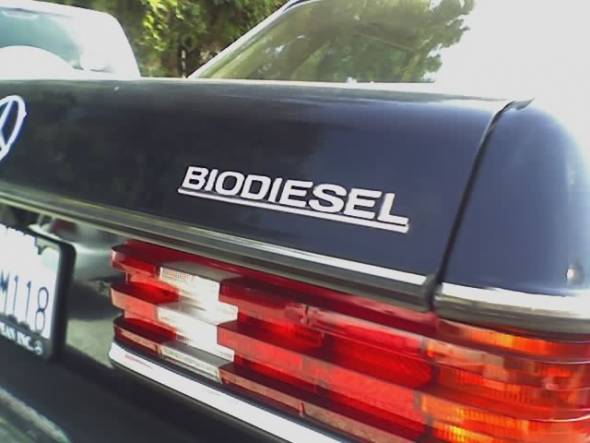
Biodiesel is probably one of the most popular homemade fuels. It is easy to make and easy to use, as long as you have a diesel engine to put it in.
Biodiesel is made from vegetable oils and is mixed with an alcohol, then dried and filtered. Some diesel engines can use vegetable oil directly in SVO (Straight Vegetable Oil) setups, although some problems can arise.
The diesel engine is often more efficient than a gasoline engine. For this reason, these engines are popular in countries that have expensive gasoline or fuel distribution. Diesels also enjoy higher torque at low speeds, making them the preferred alternative for work vehicles like tractors and trucks. Diesels are known to last a long time, and some stationary engines, like the Lister Clones or Changfas, can last more than 100,000 hours between overhauls. There is virtually no gasoline engine manufactured today that can meet these specs, or even half of these specs.
Biodiesel production begins at the plant. High oil output is a top concern, because oil production is low per acre, so special care should be taken to pick a high output crop that is well suited to your environment. Canola is often chosen because of its high output per acre, but several other crops are possible. Don’t expect more than 100-200 gallons of oil per acre. The oil usually comes from the seed part of the plant, and those parts will need to be crushed, pressed, and heated to extract the oils. Some oils will need pre-processing to get rid of the free fatty acids before biodiesel production.
Processing the oil can be done in the back yard, but special care must be taken because it involves potentially lethal processes and chemicals. Home refineries are available at low cost, but most are easy to make yourself. Be sure to research your recipe well, to insure that you can obtain the chemicals needed, like lye or methanol. Most chemicals could technically be produced at home, but beginners are advised to start simple, and work towards complete production.
Once you get your biodiesel refined, you can pretty much use it in any diesel engine. Many diesel fans swear that biodiesel is better for the engine and gives more energy output, however these claims differ between techniques and recipes.
Biodiesel is the closest thing we have to the alternative fuel silver bullet. It is easy to produce and easy to use. The problems lie in the fact that overall, it is not very efficient on space to grow crops specifically for oil, due to the low oil content in the crops. Efficiency can be increased by using crop residues for animal feed or feedstock to another biofuel system. Many people argue that it is unethical to use cropland to grow fuel instead of food, and this is especially important in low-output crops like oils. Care must be taken to avoid competition between energy and food resources.
Using waste oil, from, say, fast food restaurants, increases the appeal of biodiesel, as you are using a waste stream, and therefore making that original oil go further.
A slight variation on biodiesel is using things like waste motor oil. Some adaptations will be needed. However, if you mix this oil with some gasoline, it can be a very viable option.

Butanol is a higher energy alcohol than ethanol (105 kBtu vs 70 kBtu per gallon), making it an attractive alternative to ethanol. But, it also has some disadvantages.
Because butanol is more powerful than ethanol, it does not require engine modification like ethanol, which gives it an advantage. However it is more difficult to make, requiring higher levels of distillation energy because the max concentration is 2.5% vs 14% for ethanol.
Butanol can be made from all the same feedstocks as ethanol, but it is not made with yeast, rather 2 different bacteria. One bacteria turns the sugar and starches into butyric acid, and then another takes over and turns this into butanol. This process is historically referred to the ABE process, as Acetone, butanol, and Ethanol are produced simultaneously, however 2-3 times more butanol is produced than Acetone.
The trouble with butanol has always been in the purification process. Because concentrations above 2.5% start to kill the butanol making bacteria, several methods are being explored for increasing output. One is genetic modification of the bacteria, but for our DIY fans, absorption or molecular sieves seem to be the best bets. There are several hydrophobic membranes out there that will allow butanol to pass, but will prevent the water from going through. This is like a water filter and allows for a continuous flow production. Absorbing the butanol into an oil or solid material could also prove to be very efficient. As of 2008, no open-source butanol projects employing these methods have been published. Hopefully, someone out there will make this happen.
Using butanol is super easy. Put it in your car and go! Folks have made cross-country journeys on butanol and have proved that lower emissions and one-to-one replacement of gasoline is completely viable. If we can get the production side of butanol figured out, it could become the next wonder-fuel.
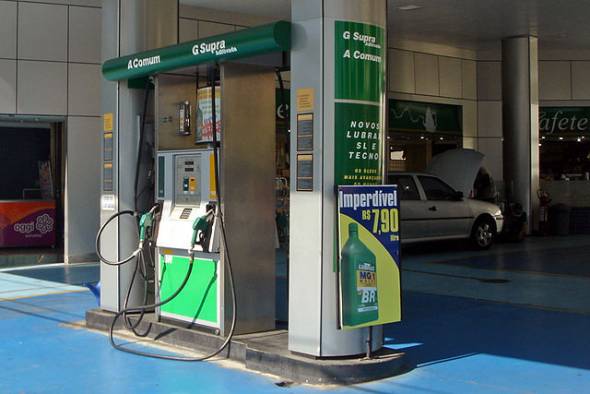
Ethanol is a basic biofuel that can be made by just about anyone. The issues in making ethanol, however, create problems even for pros!
The whole trick is quality of the finished product, or how much water is contained in the final output. Getting the water out involves different “tricks” for separating the ethanol, which loves water. On top of that, ethanol can be corrosive to certain metals, and can eat plastics and certain rubbers. So, modifying your vehicle or engine to use ethanol is a must.
Ethanol is basically alcohol from sugar. We won’t go into details on what ethanol actually is, but for now, just think of it as really strong liquor, like everclear. Actually, most of the time, ethanol needs to be 80% pure or better to run in your vehicle. If you are mixing it with gasoline, like in E85 mixes, it needs to be 98% pure or better.
Ethanol can be made from anything that contains sugar. Of course, it’s easier to make it from something that has a lot of sugar. Forget about making it from corn, as corn doesn’t contain as much starch (complex sugar) as other, easier to grow crops. Jerusalem Artichokes are considered the most productive per acre, and the nice thing about them is that you get a lot of extra biomass to feed your methane system! Cattails can be another great feedstock, with production levels of over 1,500 gallons per acre (which is five times higher than average corn yields).
Once you have your feedstock, you mix it with water and yeast to ferment it for a few days. It is best to boil this “mash” before adding the yeast to kill off any wild bacteria, fungi or yeast that might be in there. Everything loves sugar, and you don’t want them to compete with your alcohol-producing yeast. If you have a decent amount of sugar in the feedstock (20-25%) you can get up to 14% ethanol content, but most beginners are doing good to get up to 8% ethanol. Filter your mash to clean any solids, and you are ready to purify your mash.
Ethanol loves water, and this creates problems for us, because water doesn’t burn so well. A little water is ok, if you are using the ethanol directly, but more than 20% water is probably not going to run too well. There are several ways to take water out of something. The most common is distillation, which involves heating the fermented mixture just beyond the boiling point of alcohol (lower than boiling point of water), and then condensing the vapor back into a highly concentrated liquid. This isn’t as hard as it seems, but efficiency is low, and you have to generate heat to make it work.
Another method of separating water and ethanol is to use a chemical or material to absorb the ethanol from the water. Then, you will need to separate the said material from the ethanol, which may be easier than distillation, if it has a substantially higher boiling point than water. Sulfur and oils are usually used in this process, but you can also use special membranes and water absorbent materials.
So, once you get your ethanol to a relatively pure state, you need to be able to use it. This is the rub with ethanol. It has a lower energy content than gasoline (70 kBtu vs 125 kBtu per gallon) so, you have to burn more of it to get the same power out of an engine. This involves modifying the engine, increasing the injector or port sizes, modifying the timing, and possibly even modifying the compression ratio. Of course, once you do all of this to your engine, it won’t run as well on gasoline. Computer controlled fuel-injection engines seem to be far better in this respect, as the computer can modify the way the engine components behave, and then return them to gasoline standards when you fill up at the pump.
To top it all off, ethanol can eat some plastics and rubber, so you will need to change those components as well. This is why ethanol is most often mixed with gasoline. With the mix, the ethanol doesn’t get to eat things, and the engine mods are not as extensive. This can definitely decrease your dependence on fossil fuels, but it won’t replace it completely.
As you can see, making ethanol is not very complicated, but using it requires finesse, to say the least. And this is true for most biofuels, you either spend time and money making them, or you spend time and money making them work.